
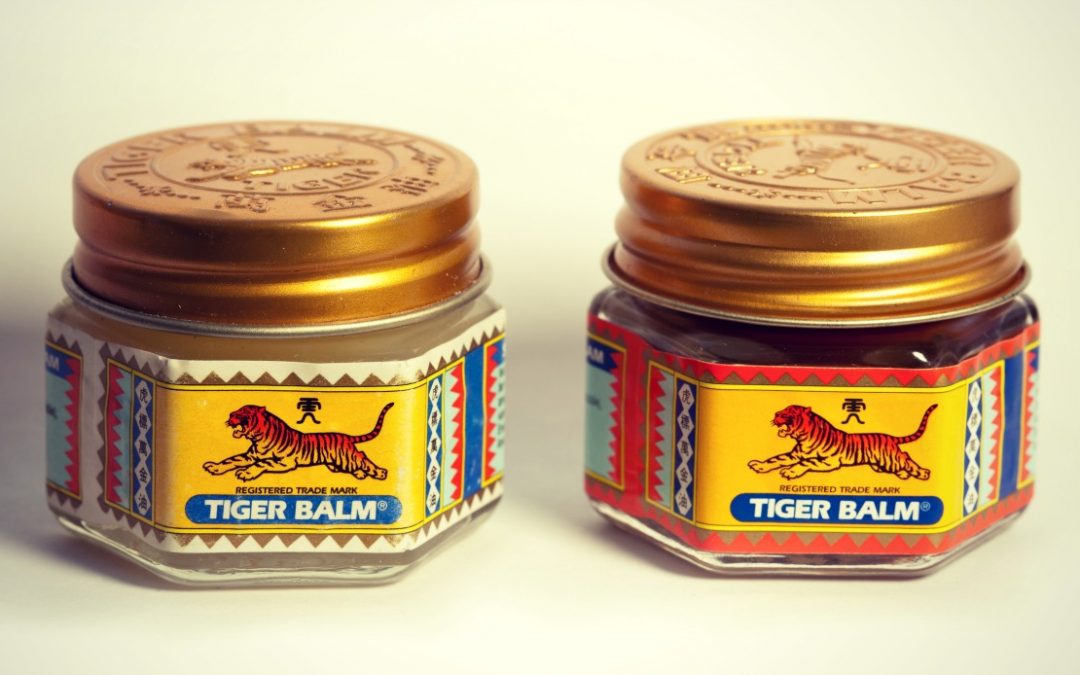
3 days ago, when I was practicing yoga, I clearly did something wrong. I don’t know what but I stepped off my yoga mat with an aching shoulder. While I was reaching for my tiger balm an idea came to my mind. Why not make my own salve for muscle aches.
I’ve been making all my lotions, soaps and other cosmetics for a while, so why not replace my good old store-bought tiger balm with a version of my own? Why did I never thought of this before?
Especially after giving its ingredients a closer look, I was more than determined to make my own. I always thought tiger balm was an ancient all-natural herbal remedy but, it contains petroleum jelly, something I rather don’t put on my skin.
After doing some research, I’ve made this recipe and it did wonders. The basic components of hot (or red) tiger balm are Menthol 10%, Camphor 11%, Mint oil 6%, Cajuput oil 7%, Clove bud oil 5%, Cassia oil 5% and petroleum jelly and paraffin. To make an all-natural version I swapped the last 2 components with beeswax and sweet almond oil.
Homemade Hot (or Red) Tiger Balm Recipe
Tiger balm can help you to reduce and soothe muscle, neck and joint pain. It helps with headaches, arthritis, rheumatism, and respiratory issues as well. Tiger balm has rubefacient and analgesic properties when applied to the skin. The active ingredients dilate blood vessels which increase blood circulation and produce warmth. This speeds up the healing process and reduces the sensation of pain.
Ingredients
- 1 gram beeswax
- 1 oz. sweet almond oil (or coconut oil)
- 1 ½ tsp. menthol crystals
- 1 ½ tsp. camphor essential oil
- 1 tsp. mint essential oil
- 1 tsp. cajuput essential oil
- ½ tsp. clove essential oil
- ½ tsp. cassia essential oil (makes the hot or red tiger balm)
- 2 oz. jar with lid (I use amber glass jars to prevent oxidation, you can order them here)
How To…
- Melt the beeswax and almond oil in a double boiler on low heat.
- Stir the mixture until liquefied and well combined.
- Add the menthol crystals and essential oils and stir well.
- Pour the mixture immediately into a clean and sterile container or jar and close the lid to avoid evaporation of the essential oils.
- Let the tiger balm cool and thicken until a cream-like consistency before applying.
- Apply on the affected areas 3 to 4 times a day.
Tiger balm is a very strong and powerful, so if you want a milder blend, add more almond oil and beeswax and tweak it to your needs. Tiger balm is for external use only and should not be used on infants under 2 years of age… And watch out for your eyes, always wash your hands after applying. Substitute the clove bud and cassia essential oil with ½ teaspoon eucalyptus essential oil and this recipe will make you an excellent homemade “Vapo-rub” when struggling with respiratory problems.
As always, your feedback, experiences, and recipes are much appreciated, so please share them with us in the comment box below.
Thanks for reading. I hope this information was helpful. Until next time!

Amy Goodrich
Crazy cat lady, life and food lover, certified biologist, and holistic health coach.



Whoa… the Tiger Balm recipe – yeah that would be hot alright – Cassia is not an essential oil recommended for skin use and that’s a lot of Clove too – highly sensitizing blend right there! I love where you’re going with this – but the eo’s chosen and the levels used aren’t within the skin safety limits… I can see that you’re going with the original tiger balm blend and simply swapping out the petroleum for natural ingredients – great idea!!! I would at least put out some safety information with this though – just so folks know what they’re getting in to here!
I do have a question on this as well, I assume you’ve been using this on yourself, knowing that Tiger Balm has been out there for years – do you find that this is not sensitizing for you?
I’m just curious as I think I might be afraid to try it myself… But if you’re using it and not having any issues – that would be excellent to know 🙂
Thanks 🙂
Hi Donna, I know it’s a lot of EOs, but the original tiger balm also contains loads of active compounds. I never had any issues with this recipe. I have used both (red and white) in the past to soothe sore muscles and help me to breathe when having a cold. If you have a sensitive skin, try on a small patch of skin first to see what happens before applying it over a larger area.
Have a great day!
I am vegan. What alternative could be used to beeswax?
Hi Andrew, candelilla wax is the vegan substitute for beeswax. You can find it on amazon: http://amzn.to/1TuaPCU Good luck!
How in the world do I measure out 1 gram of beeswax? Seems like it is less than a half teaspoon. My friend made this with marijuana coconut oil, this recipe is incredible. I place a little tiny bit on my temples, the relaxation and the mood lift is incredible. Thank you for sharing!!!!!
Hi Pauline, we have a kitchen scale that is able to weigh 1 gram. But you can always make a bigger batch (as this recipe will only make one small jar) and increase the ingredients until they are weighable for you. In fact, it isn’t an exact science, so if you are a bit off the measurements that’s fine. If the balm is too soft, add more beeswax, if too hard add more oil. Now that we live in the tropics I always add a bit more to make sure the tiger balm doesn’t lose its harder consistency. Never seen the marijuana coconut oil, thanks for the tip will definitely give it a try when I come across it. Take care!
I recently bought a book on wish called backyard medicine many it’ll work for you.
You would be surprised how many natural healing plants you can find around you. Power of nature rocks!